












News
David Chapman and Steven Michaelson will be honored by the organization at its annual awards dinner, set for February 4, 2024 in New York City
Published Oct. 24, 2023
November 1, 2023 — The Medical Advertising Hall of Fame (MAHF) has announced its 2024 inductees: Longtime Ogilvy Health leader David Chapman and Wishbone and Calcium founder Steven Michaelson.
David Chapman entered the marketing world as a junior copywriter at Alden Advertising. Following stints at Ruvane-Leverte (where he developed the first HCP CRM program) and Kallir, Philips, Ross (where he supported a range of Johnson & Johnson Rx and consumer products), Chapman joined Nelson Communications to head up MediCom, the firm’s division specializing on video sales materials for pharma reps.
But it was under the WPP aegis that Chapman truly established his leadership bona fides. He was a key cog in the growth of Ferguson Associates, CommonHealth and Ogilvy Health, becoming one of the individuals most responsible for unifying 13 distinct agency brands as CommonHealth. He also launched Altum, thought to be the industry’s first high-science specialist agency. Later in his WPP tenure, he helped write winning consolidation pitches for big swaths of Pfizer and Johnson & Johnson business.
Chapman donated his time to numerous New York City-based charities, including the Billion Oyster Project and the Hudson River Park Association. He graduated from Vassar College with a Bachelor of Arts degree in geology.
Steven Michaelson began his career in the 1980s as a designer and, later, a creative chief at some of the agency world’s most prominent companies, including FCB, Harrison and Star and Robert A. Becker. In 1998, he struck out on his own with the founding of Wishbone, which counted among its founding values both an emphasis on creativity and an absence of bureaucracy.
After selling Wishbone to Rosetta Marketing Group in 2010, Michaelson went the entrepreneur route once again when he founded Calcium in 2012. Prior to his retirement in March 2023, Michaelson engineered the November 2021 sale of the agency to NexPhase Capital. He also oversaw the launch of Calcium + Company, which houses Calcium, medcomms arm Vitamin MD, PR division PRotein and oncology unit Amino.
Charities with which he has worked closely include Haven Kids Rock, the USTA Foundation and the Community-Police Relations Foundation. Michaelson graduated from Pratt Institute with a Master of Fine Arts.
About the Medical Advertising Hall of Fame: The MAHF was founded in 1996 to preserve the history and heritage of the medical advertising profession as well as to recognize the industry’s most influential and respected forebears. Since then, MAHF has grown that mission to include recognition of past excellence in creative work, creation of educational resources and support of value of diversity, equity and inclusion in the industry.
The inductees will be honored on February 8, 2024, at a black-tie dinner at The Pierre Hotel in New York City. Seats and tables may be reserved at www.mahf.com/gala2024. For information about advertising opportunities in the Awards Dinner program or other MAHF programming, please contact MAHF executive director Anne Gideon at anne@mahf.com.
Reflecting on my career in healthcare and pharmaceutical advertising, I’ve witnessed a profound transformation in how we use data in media planning and activation. I began my career at BBDO in the mid-90’s, when the agency had its own dedicated media planning group, long before the rise of OMD and OMG. At that time, health-related consumer campaigns largely relied on a combination of demographic and psychographic data from tools like MRI, Simmons, and Nielsen. For example, we could determine that CBS Nightly News attracted an audience of adults 45 and older with an interest in health-related topics. These historical insights into where our audience was consuming media was all we had to inform our strategies and where to place our advertising.
Two major shifts changed the landscape of health advertising. First, the rise of digital advertising brought contextual targeting. This was revolutionary because, for the first time, we could directly target the content of an article tied to a specific health condition or product. While this was a breakthrough, scale quickly became a limitation, since only a certain number of people would be reading that content at any given time. This prompted the rise of audience extension and third-party modeling to expand our reach beyond those directly consuming specific content.
On the HCP side, vast amounts of data always existed in the form of paper-based medical records. Companies like IMS Health, SK&A and Quintiles aggregated this data for companies to use mostly to inform their in-person sales efforts. When the Hitech act was passed in 2009, it accelerated the adoption of electronic health records (EHRs). This gave birth to a new industry of digital health data. Companies like DMD and MedData Group—both now part of IQVIA—were pioneers in building robust healthcare provider (HCP) audiences.
As programmatic advertising matured, demand-side platforms (DSPs) like DeepIntent, PulsePoint, Lasso and The Trade Desk emerged as critical players for more precise, data-driven targeting. And measurement companies like IQVIA and Crossix, now owned by Veeva, introduced audience quality metrics, allowing advertisers to better understand the reach and relevance of their campaigns, providing a critical link between marketing activities and measurable health outcomes.
This evolution from traditional media to digital and programmatic platforms made advertising personalization the status quo. The number and complexity of datasets being used increased, and with this, concerns about customer privacy also grew. In 2018, Apple launched Intelligent Tracking Prevention (ITP), which eliminated the use of third-party cookies for tracking. These were among the forces that prompted the formation of a whole new set of companies focused on developing new methods for organizing and utilizing data while prioritizing customer privacy.
A Brief History of Health Data
We have come a long way from the siloed and fragmented early days of paper chart data and historical media demographic data to the current era of digital health ecosystems. Data is everywhere – and in usable formats – and plays a crucial role in shaping not just how advertisers implement campaigns, but also how care is delivered.
It is helpful to trace its evolution, to fully understand its power. I think of data in two categories, clinical data and digital data. They evolved on similar and synergistic trajectories, with advancements in one accelerating developments in the other.
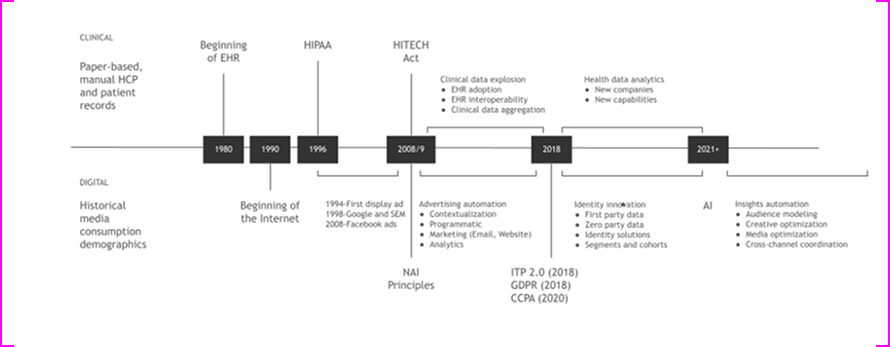
So Much Data, So Many Possibilities
With this explosion of data and the advancement of advertising technologies, healthcare advertising has evolved into a highly sophisticated, data-driven practice. Let’s take a look at how advertisers are reaping the benefits from this evolution.
Precision Targeting
Precision targeting dominates the healthcare advertising landscape. Using rich data sources such as demographics, digital behaviors, health behaviors, and prescribing patterns, advertisers can precisely target the specific audiences that are most relevant to their brands, such as physicians in certain specialties treating a specified population, or patients likely to have been just diagnosed with a condition. This allows for more efficient ad spend, more relevant messaging that connects with the right people at the right time, and effective achievement of business objectives.
In healthcare, advertisers cannot target consumers 1:1 based on their health information. Instead, direct-to-consumer (DTC) advertisers use audience modeling to find lookalike audiences that share similar characteristics with their target audience. For example, through modeling, advertisers can reach patients who haven’t directly searched for a specific condition but exhibit similar behaviors or interests as those who have.
Omnichannel Campaigns
By integrating customer data and channel activation across various touch points—digital, mobile, social, email, TV, and even in-person events—healthcare brands can deliver consistent, personalized messaging that is coordinated across multiple channels. More advanced omnichannel campaigns track the customer’s behavior over time and personalize the next message served based on the previous behavior exhibited. This is called Next Best Action. Omnichannel strategies ensure that a consumer or HCP receives the right message for the stage of the journey they are in – no matter what platform they are on. This strengthens the value for the customer, enhances their brand experience, and drives campaign impact.
Advertising campaigns can now use machine learning and AI to automatically measure, analyze and optimize campaigns in real time based on performance data. These advanced predictive models use historical data to predict future behaviors, such as a patient’s likelihood of seeking a particular treatment or a physician’s propensity to prescribe a specific medication. Algorithms adjust bidding, targeting, and creative elements to maximize performance, such as media engagement or conversion (e.g., NRx or TRx), and improve efficiency, without human intervention.
Challenges You Need to Know About
While data has opened up a whole new world of possibilities for advertisers, it is not without its challenges. Below are some of the most significant:
Data Volume and Complexity
The sheer volume of data available for healthcare advertising has grown exponentially. Digital data around user behavior and preferences, clinical data and demographic and environmental information are being gathered and integrated at an unprecedented scale. This data is far more granular and complex than what traditional advertising methods relied on. Managing and processing such vast datasets can be slow and costly, making it essential for advertisers – or more realistically, their data and technology partners – to find efficient ways to connect, integrate and make this data actionable.
Privacy and Data Security
Patients, increasingly concerned about the use of their sensitive health information, especially in targeted advertising, have prompted stricter regulatory controls on data usage. Legal frameworks like the Health Insurance Portability and Accountability Act (HIPAA), Network Advertising Initiative’s Self-Regulatory Code of Conduct for Online Behavioral Advertising (NAI), California Consumer Privacy Act (CCPA), other state level regulations, and General Data Protection Regulation (GDPR) in Europe, set rigorous standards for the collection, storage, and use of healthcare data. Advertisers must adhere to these regulations to responsibly leverage data for impactful campaigns while maintaining trust and compliance. Many organizations are adopting “privacy by design” principles, ensuring that data privacy and security are built into their advertising strategies from the outset. This involves greater reliance on first-party data and anonymizing data wherever possible.
The Shift Away From Cookies
Privacy concerns and regulatory changes have pushed the industry towards reducing their use of cookies and instead prioritizing first-party data, which is information collected directly from users with their explicit opt-in and consent to use that information for advertising, and anonymized identity data, which has been processed to remove any personally identifiable details but preserves attributes that make it useful for targeting. As a result, healthcare advertisers have started to invest more heavily in building their own first-party data from interactions with their digital platforms and working with a new set of alternative identity vendors to power their campaigns.
Measurement and ROI
As healthcare advertising becomes more data-driven, measuring campaign effectiveness and return on investment (ROI) has become increasingly complex. While measurement companies have introduced more sophisticated measurement capabilities, the challenge of linking advertising activities to actual patient outcomes persists. The only way to realistically determine how ads influence health behaviors, treatment adherence, and ultimately health outcomes, is through the use of advanced data analytics and long-term tracking. These capabilities are still emerging in the healthcare advertising space, where integrating such advanced skill sets is in its early stages or concentrated in a few select companies.
Ethical Use of AI
As AI becomes more integral to healthcare advertising, advertisers will need to ensure that AI is used responsibly, that patient data is handled with the highest levels of privacy and security, and that models are trained to avoid misuse or unintended bias and promote health equity. With regard to health equity, there is a risk that underserved populations could be left behind if they are not adequately represented in datasets.
A “Who’s Who?” in Healthcare Data Management
Managing data in healthcare advertising has required a range of specialized companies that handle various aspects of data collection, analysis, compliance, and activation. Each of these types of companies provides unique expertise, and together they form a data ecosystem that enables healthcare advertising to function efficiently and compliantly. Here are the different categories of companies typically involved, with some examples that stand out in the field:
Health Data Aggregators
Health data exists in many different forms – office-based, in-patient, labs, pharmacy, medical supply, infusion centers, etc. Aggregators bring all of this data together and organize it to support decision-making for marketing, advertising and sales.
Example companies: Definitive Healthcare, Cegedim, Optum
Health Audience Companies
These are companies that build HCP or health consumer audiences at scale based on criteria that are useful to health advertisers.
Example companies: HCP audiences – DMD, Med Data Group (both are a part of IQVIA), DTC audiences – Swoop, Crossix, Symphony Health (ICON)
Data Management Platforms (DMPs)
DMPs collect, organize and segment large volumes of data (e.g., user behavior, clinical data) from various third-party sources. They help advertisers create targeted audiences based on anonymized or aggregated data.
Example companies: Tealium, Segment, Adobe
Customer Data Platforms (CDPs)
CDPs focus on creating unified customer profiles primarily based on first party data from sources such as CRM systems and digital interactions, providing a single view of the customer for personalized marketing.
Example companies: Salesforce, Tealium
Identity Resolution Providers
These firms anonymize and de-identify healthcare data, allowing advertisers to work with customer attributes without violating privacy regulations.
Example companies: Throtle, Live Ramp
Health Tokenization Companies
Health tokenization companies securely convert health data into encrypted digital tokens so that they can be shared across platforms while preserving patient privacy.
Example companies: Datavant
Alternative ID Companies
Alternative ID companies create customer identification solutions that replace third-party cookies with anonymized, consent-based identifiers.
Example companies: UID (The Trade Desk), ID5, NonID, and PanoramaID
Measurement and Analytics Companies
These companies analyze healthcare data to derive insights, such as script writing behavior, patient compliance and treatment outcomes. Advanced analytics help measure campaign attribution and optimize future strategies.
Example companies: Crossix (Veeva), IQVIA, HealthVerity, Komodo
Programmatic Advertising Platforms
These platforms – demand side platforms (DSPs) and supply side platforms (SSPs) automate the buying and placement of ads based on real-time bidding and data signals.
Example companies: DeepIntent, PulsePoint, The Trade Desk
Third-Party Data Providers
These companies supply external data, such as demographic, geographic, clinical or environmental (e.g., weather), which can be used to enrich healthcare advertising campaigns and create more precise targeting models.
Example companies: Experian, Acxiom, Epsilon, The Weather Channel
Looking Ahead
There’s no doubt that the future of health advertising is data-driven. Looking ahead, I believe that our collective use of digital platforms will continue to increase, and AI will play a bigger and more integral role in the industry. For health advertisers, the key will be to stay informed of these changes, challenge your teams and partners to give you the best advice that’s reflective of an honest evaluation of the market, and use data to serve patients responsibly while also delivering hard results against campaign objectives.

Connect With Us
Interested in learning more about the Medical Advertising Hall of Fame, its goals and activities, membership or events?
We are happy to help!